What if we told you that within your current web pages lies the potential to not only enhance your rankings for your primary target phrases but to dominate a multitude of other semantically related searches?
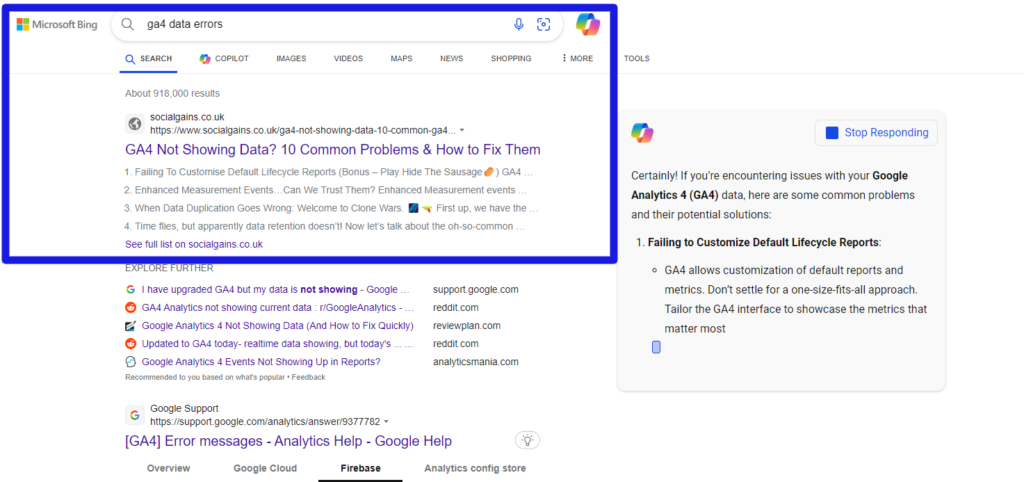
This is the same approach we use to dominate Bing for 1000’s of keywords like “GA4 Data Issues” or “GA4 Data errors“.
This AI SEO strategy is ideal for pinpointing a specific page on your website and devising a precise strategy to boost its ranking swiftly, rather than relying on potentially vague keyword research tools.
This isn’t just another AI SEO tactic. To me, it’s truly revolutionary. Receiving clear guidance on enhancing a particular page and leveraging our current rankings data has eliminated the need for keyword research, as we’re already positioned well.
If you implement the steps below or by watching the YouTube video you’ll be scrolling through your analytics to see your rankings climb and your traffic soar.
Prerequisites:
To get started, ensure you have the premium edition of ChatGPT 4 to unlock the Advanced Data Analysis feature. Additionally, you’ll need access to a Google Search Console property with a solid keyword history.
Ready to get started?
Table of Contents
Step 1: Login into Google Search Console.
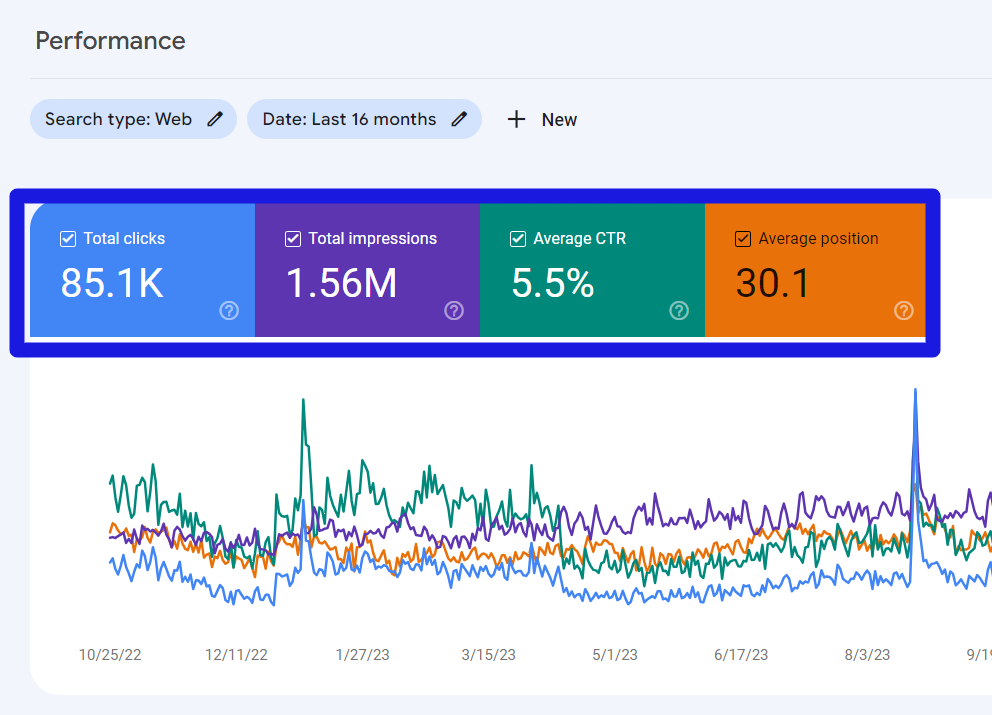
Ensure all four metrics are activated: Total clicks, Total impressions, Average CTR, and Average position.
Step 2: Create a Query filter to exclude branded (company name) queries.
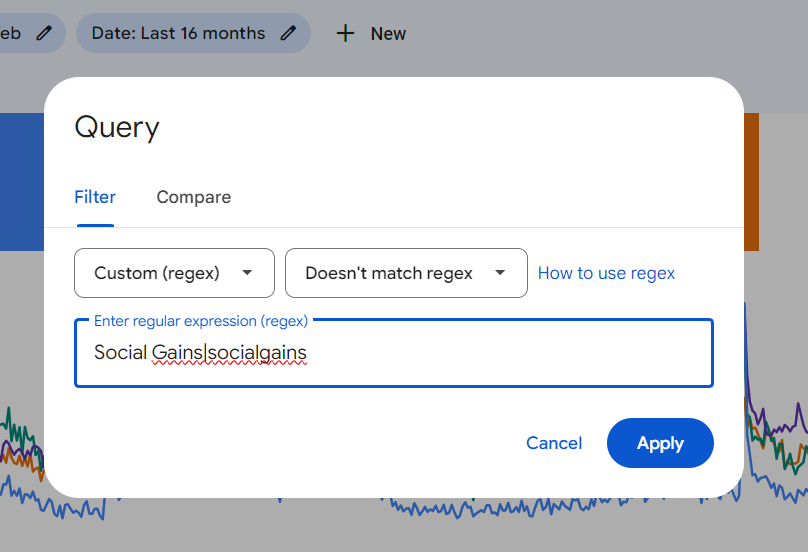
Use custom regex if you need to filter out brand name permutations. Watch the video above for further instructions – just use the | symbol to separate brand name permutations.
Step 3: Select a specific URL by creating a Page filter to show just the URL that you want to improve SEO for.

Step 4: Export the queries SEO data to a CSV file. The export will provide a ZIP file with multiple files; focus on Queries.csv. Verify its contents.
Step 5: Login into ChatGPT-4, ensuring you’ve signed up to the premium version and create your first prompt.
Prompt 1: I’ve shared Google Search Console data showing the search performance of a URL. Can you analyse it? You also need to upload the queries data from the Google Search Console report.
Ready to stop playing small? Stay Ahead or Get Left Behind: Unlock the Latest Trends.
Plug-n-Play Strategies for Success Delivered Directly to Your Inbox. Grab a copy and gain access to our transformative £2 million Accelerator Growth Framework. Don’t let your rivals outpace you.
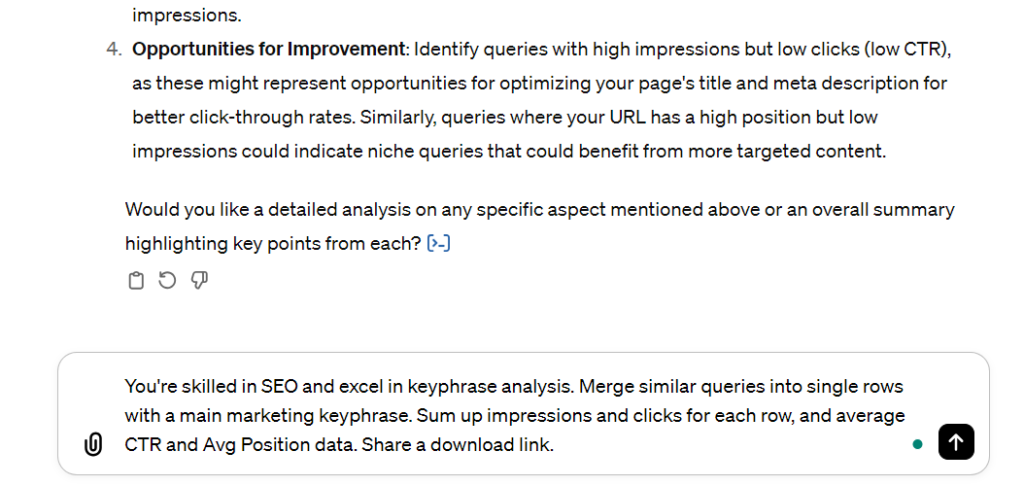
Step 6: Next up, give ChatGPT4 a role to consolidate the data. The dataset might have loads of similar phrases, not all of which are needed. Each time we ask the AI to tweak our data, we’ll download and double-check it.
Prompt 2: You’re skilled in SEO and excel in keyphrase analysis. Merge similar queries into single rows with a main marketing keyphrase. Sum up impressions and clicks for each row, and average CTR and Avg Position data. Share a download link.
Note: When you ask AI to work on data in a file, make sure to request a link to download the updated file and give it a careful check. Errors happen, so it’s important to verify.
Step 7: Now we are on to the good stuff – The AI will handle text preprocessing and keyphrase extraction for us.
Next, we’ll ask it to provide in-depth SEO on-page tips. To maintain a natural flow and avoid keyword stuffing, we’ll gently remind it to preserve readability.
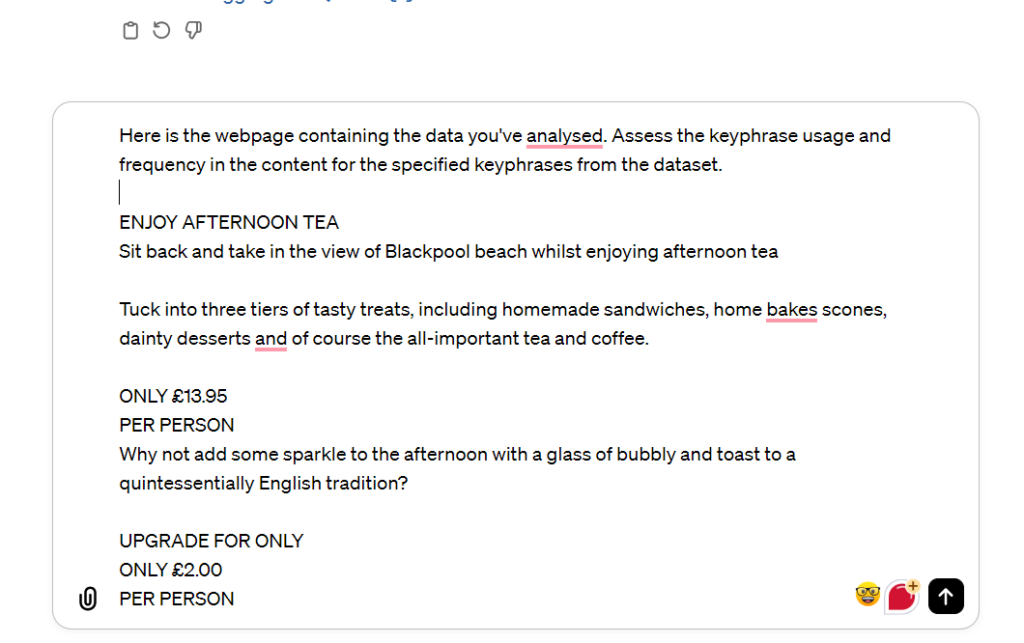
You’ll also need to paste in the copy from your target page, literally just copy the text from the target page and place it under the prompt as per the image below.
Prompt 3: Here is the webpage containing the data you’ve analysed. Assess the keyphrase usage and frequency in the content for the specified keyphrases from the dataset.
Step 8: It’s now time to challenge ChatGPT and unearth some detailed ranking insights.
Prompt 4: Provide SEO suggestions for enhancing this page’s rankings by better signifying its relevance for the keyphrases in the Google Search Console dataset. Focus on incorporating key phrases not currently used on the page but present in the dataset. Offer recommendations to enhance content flow, quality, and keyphrase relevance, highlighting the proposed adjustments.
By this point, you should be blown away by the amount of value your $20 investment has generated. I know I was the first time I used it.
The final step involves reviewing the recommendations. Consider declining some, refining others, and updating the page.
Similar to optimising a page for improved rankings, track the keyword in your preferred SEO tool. Evaluate ranking changes after a week and traffic changes in GA4 after a month.
If you’ve got this far – drop me a note below if you’ve tested this out. I am keen to get your feedback.
FAQ’s
How to Use AI for SEO (Effectively)
Google Search’s guidance on AI-generated content stresses the significance of creating original, top-notch content that prioritizes E-A-T (expertise, authoritativeness, trustworthiness, and experience). The company values content that aligns with these criteria, irrespective of whether it’s crafted by humans or AI. Surprisingly, Google has been utilizing AI to produce weather forecasts, sports scores, and transcripts for quite some time.
Does Google penalise AI Content?
You don’t have to be an SEO expert to notice that generative AI content has been making its way into Google search results over the past year. The debate around Google’s use of interaction data to assess quality has always been a heated topic. I firmly believe that Google mainly relies on interactions within their SERPs, rather than on websites, to evaluate content quality. If you’ve been paying attention to those in the know, Google has been quite open about using click data to determine content rankings. In 2016, Google engineer Paul Haahr shared insights during his talk “How Google Works: A Google Ranking Engineer’s Story” at SMX West. Haahr delved into Google’s SERPs and how the search engine analyses shifts in click patterns. He highlighted that this user data is more complex to decipher than one might anticipate.
Is AI replacing SEO?
Instead of being replaced by AI, SEO is advancing in parallel with it. AI supports SEO experts by automating routine tasks, offering profound insights, and refining decision-making processes. AI-driven SEO tools are an excellent aid to marketers, ensuring that their efforts are aligned with Google’s algorithms and users’ search intent. In this way, AI is transforming the traditional SEO landscape and giving marketers a competitive edge in their digital marketing strategies.